


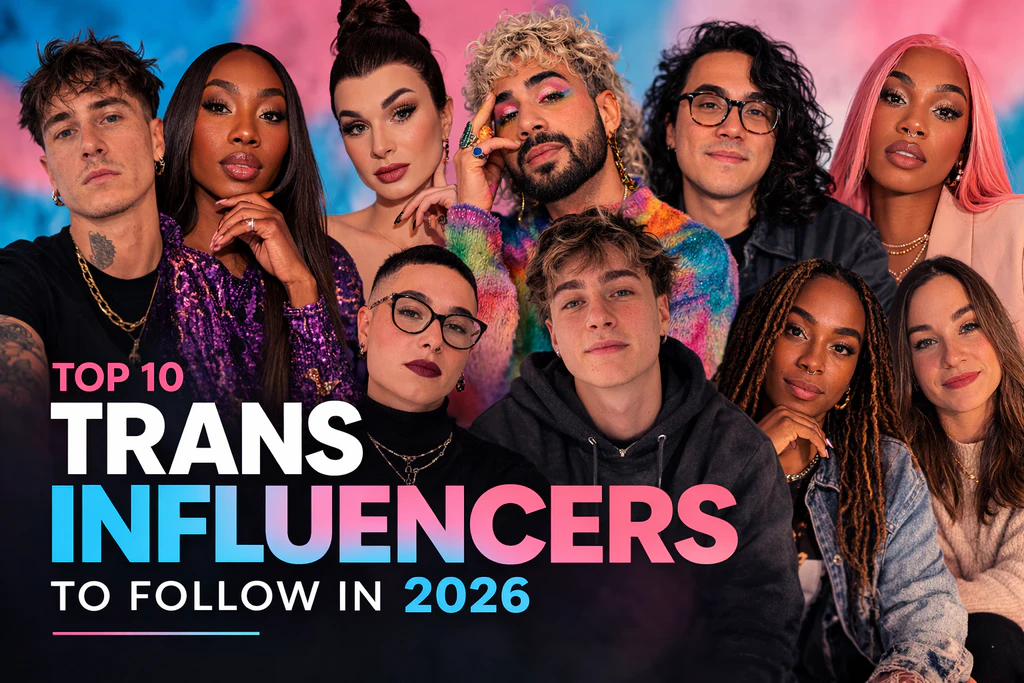
Top 10 Trans Influencers to Follow in 2026
Editor:
Leona HambArian

Author:
Olena Kosonogova
Olena Kosonogova (she/her) is Chief Information Officer at Fiorry. Olena brings a background in social work and psychology, which gives her a unique perspective on information strategy, systems thinking, and user-focused infrastructure. She oversees data flows, internal systems, and the alignment between technology and communication across the platform. Drawing on her experience in public relations and strategic operations, she helps ensure that Fiorry’s information architecture supports both growth and clarity. Outside of work, Olena values balance through tennis, spending time outdoors, and challenging her mind with a thoughtful game of chess.
Key Takeaways
Social media reshaped how stories reach people. It changed who gets to tell them in the first place.
Trans influencers and other LGBTQ+ influencers now speak directly to global audiences, without anyone else filtering the message. A decade ago, that kind of reach simply didn’t exist at the same scale.
The trans community and broader LGBTQ+ community now have voices online who cover everything from policy and human rights to art, education, and daily life as trans people. Some are journalists. Some are creators who started with nothing but a phone and something to say. Their content doesn’t follow one line. It covers the full range of what being LGBTQ+ actually looks like day to day.
The ten famous creators on this list span different backgrounds, formats, and corners of the world. Many of these transgender influencers built their audience on platforms like YouTube, TikTok, and Instagram, where personal storytelling and educational content can reach millions of viewers.
Why Trans Influencers Matter in 2026
Trans influencers filled a gap that mainstream media spent decades ignoring.
If a transgender person appeared on television at all, it was usually someone else’s story, told by someone else. The internet broke that pattern. A teenager in a small town could suddenly find a creator who’d asked the same questions they were too afraid to say out loud.
That’s what made it different. Not the follower counts — but the specific feeling of finding out you weren’t the only one.
Top 10 Trans Influencers to Follow
- Dylan Mulvaney
- Alok Vaid-Menon
- Munroe Bergdorf
- Raquel Willis
- Alejandra Caraballo
- Erin Reed
- Jamie Raines
- NoahFinnce
- Angelica Ross
- Paris Lees
Dylan Mulvaney

Dylan Mulvaney’s online story began in 2022. That year she started posting short daily videos titled Days of Girlhood on TikTok. Each clip captured small moments from her transition. Nothing complicated, just daily life on camera.
She’s a transgender woman and a performer. That second part matters. The videos about gender and everyday life had timing, warmth, and a punchline when you least expected it. A scene of buying jeans. A bad hair day. Small stuff. Her own experiences, not talking points. Trans people found her and felt recognized. People with no personal connection to the trans community found her and stayed anyway.
That crossover is what turned a video diary into something that reshaped how brands think about influencer marketing and transgender influencers as a category worth taking seriously. The fame caught up with her fast. But the videos that started it were never about fame. It was simply one transgender woman sharing pieces of her life online, day by day, for anyone who felt like watching.
Alok Vaid-Menon

Alok Vaid-Menon moves between poetry, performance, and public speaking. Any short description leaves something out.
Their work covers gender, identity, fashion, their own experiences, and the space between all of those things. On stage they perform. Online they post. Essays from a poet, photos, short reflections. Different mediums, same thread running through it: the way society decides who gets to exist visibly and who doesn’t.
The queer community found in Alok a voice that didn’t simplify things to make them easier to swallow. That’s not common. Most public speakers in this space pick a lane. Alok didn’t. The spotlight they’ve built came from that refusal. Posts that combine fashion and commentary. Performances that are art first, activism second. A following that crosses the usual lines of who pays attention to conversations about gender.
Munroe Bergdorf

Munroe Bergdorf is a model, writer, and activist. She’s also one of the most visible trans women in British media, which didn’t happen by accident.
Her recognition started in fashion. Beauty campaigns, major publications, British GQ. From there she kept moving. Interviews, essays, public speaker slots at events where those conversations actually matter. She didn’t stay in one lane.
What she talks about is consistent, though. Identity, representation, and what life looks like for transgender people in practice, not in theory. The transgender community gets an advocate who knows how media works from the inside. That combination is useful in ways that pure activism rarely is.
She raises awareness about human rights issues affecting trans people around the world without making that the whole personality. The fashion is real. The advocacy is real. Bergdorf is one of the influential people who figured out those things don’t have to compete with each other.
Raquel Willis

Raquel Willis is an activist, writer, and public speaker. In 2025, TIME named her a Woman of the Year. She’s been writing about trans people and trans rights for years. Teen Vogue, TIME, Essence, and them. The work isn’t just reporting. Willis tends to put her own story inside the political analysis, which makes the human rights stuff land differently than a straight news piece would. Her book, “The Risk It Takes to Bloom: On Life and Liberation,” does the same thing in longer form. It looks at how visibility and narrative actually move the needle on social change. Not in the abstract. Through real examples. The transgender community has a lot of advocates. You will find Willis writing articles one week and speaking at events the next. Across those settings she focuses on raising awareness without pretending the experiences of transgender people are simple or easy to summarize. The TIME recognition didn’t make her. It just confirmed what the trans community already knew.
Find Community Beyond Social Media
Following influencers online can create the feeling of being part of something. The comments, the shared posts, the short moments of recognition. But sooner or later many people realize that watching from a screen is not quite the same as having real friends around.
Videos and posts help people discover each other. They do not always build community on their own.
For many trans people, meeting others in everyday life still takes effort, especially outside major cities. Some start small. A search for a local trans boy nearby. A small group chat. Sometimes an app where conversations feel relaxed rather than staged for an audience. What most people are really looking for is simple: other people who understand daily life inside the trans community.
That is where dedicated platforms can help.
Spaces built specifically for trans and LGBTQ+ users tend to make those first connections easier. Fiorry is a ts dating site created for people who want something genuine. For some users that means dating. Others are simply hoping to meet new friends, talk openly, or find their place inside a welcoming community.
Join Fiorry to meet people who understand your story.


Alejandra Caraballo

Alejandra Caraballo is not a singer, performer, or internet star. Her background is in law. That difference explains why many people pay attention to what she says online.
Caraballo works as a clinical instructor at Harvard Law School’s Cyberlaw Clinic. The focus there sits at the intersection of technology, online speech, and LGBTQ civil rights. Earlier in her career she worked as a staff attorney at the Transgender Legal Defense and Education Fund and later with New York Legal Assistance Group. The work has always centered on legal advocacy and public interest law.
What draws people to her posts is something simpler: clarity. Legal debates online often move quickly and leave most readers behind. Caraballo tends to slow that down. When a new policy appears or a court case begins to move through the system, she breaks it apart and explains what is actually happening. For many readers, that kind of educational resources is more useful than commentary or reaction.
Caraballo is also a trans person with a visible platform. But the attention around her work is rarely about personality alone. People follow her because she can educate. Complex legal language becomes understandable, and fast-moving policy debates start to make sense.
Erin Reed

Erin Reed didn’t build her following through entertainment. No viral clips, no performance. People found her because they were confused about what was happening in policy, and she was one of the few people actually explaining it.
She covers legislation affecting trans men, transgender youth, and the broader transgender community across the United States. That means reading a lot of dense legal text. Court rulings, healthcare bills, and debates around gender dysphoria. The kind of material most readers bounce off of immediately.
Reed doesn’t bounce off it. She goes through it and writes up what actually changed and for whom. Not the reaction. The substance.
That’s rarer than it sounds. Policy debates move fast, headlines are vague, and the details disappear inside the noise. Her newsletter and social media account slow that down. She publishes across various mediums, long reads and short commentary alike, but the approach is the same either way.
The audience grew beyond the usual policy circles because of that. She has global recognition now among readers who want analysis they can trust rather than another hot take.


The fight for rights is seldom straightforward; success does not come without setbacks
Jamie Raines and His YouTube Channel

Jamie Raines built his audience in a quieter way than many online creators. Instead of chasing viral moments, he focused on longer conversations on his YouTube channel.
The setup is usually simple. Jamie speaking directly to the camera. Sometimes he brings in research, sometimes he talks through personal experience. Many videos touch on transition, healthcare, and gender dysphoria, but the tone stays informal. The channel feels more like a discussion than a lecture.
Raines also talks openly about life as one of many trans men navigating identity, relationships, and public perception. Some videos lean into research and explanation. Others stay grounded in everyday moments. Over time that mix turned the content into informal educational resources for people trying to understand the experiences of transgender men.
The audience gradually widened. What began mostly inside the community now reaches viewers who simply want clearer explanations about gender and social change. Raines continues to educate in a calm, direct way that makes complicated topics easier to follow.
NoahFinnce

NoahFinnce first found an audience online through personal videos about transition and everyday life. Those early posts were candid and sometimes chaotic. Over time, though, the focus shifted. Music gradually moved to the center of what he does.
Today he is best known as a musician. Fast, energetic songs. Lyrics that feel direct and personal rather than polished. New releases usually arrive with music videos that keep the same spirit as his early content. Some are funny, some a bit messy on purpose. Many circle around identity, friendship, and the strange process of figuring yourself out.
The audience grew far beyond the people who watched the first videos. Viewers from different spaces online started following the project as the music developed. RuPaul’s Drag Race made drag culture far more visible to mainstream audiences. NoahFinnce represents another route entirely. Independent music, online platforms, and a fanbase that formed gradually.
Over time the audience started to feel more like a small community than a typical fanbase.
Angelica Ross

Angelica Ross is an actress, a businesswoman, and an activist. Not in sequence. All at once, for years.
A lot of people found her through Pose. She played Candy Ferocity, a trans woman in a major TV drama at a time when that was still genuinely uncommon. American Horror Story came after. The visibility stacked up.
But the acting was never the whole thing. Ross has spent a long time working on what opportunities actually look like for people inside the trans community, specifically in tech and media. That work got recognized with the Queerties Groundbreaker Award. The kind of recognition that goes to people doing the less visible stuff, not just the stuff that ends up on screen.
As an artist she’s an inspiration to younger creators in a specific way. Not the vague “follow your dreams” kind. More like proof that films, television, activism, and building something in tech can occupy the same career without one canceling out the others.
That combination is what makes her interesting. The performer and the organizer are the same person.
Paris Lees on Instagram

Paris Lees made her name as a writer and journalist. Instagram gave her somewhere to be less formal about it. Her posts don’t follow a pattern. Growing up working class in the UK one day, thoughts on representation in TV and movies the next.
Sometimes it’s cultural commentary. Sometimes it’s just a story she felt like telling. There’s no clear editorial line, and that’s probably the point.
She doesn’t perform polish online. Nothing feels drafted. People outside the usual journalism circles noticed that and stuck around.
People follow her because she’s an advocate who doesn’t separate the personal from the political. The culture stuff and the lived experience stuff sit in the same post, sometimes the same sentence. Readers around the world who care about gender and identity find that more useful than a clean argument with a conclusion.
How to Find Authentic Trans Creators Online
Good accounts are hard to fake for long. The ones worth following tend to post like they’re talking to someone, not performing for an algorithm. Real stories, not a brand. Uncertainty, not perfect answers.
Most people find them the same way. You watch how someone talks about their own experience. Whether they admit to getting things wrong. Whether the small details are there or just the highlights. That stuff is hard to manufacture consistently.
Communities form around that honesty. Not because people go looking for a movement, but because openness attracts openness. Over time the comment sections start to feel like something.
For some people, following creators online leads somewhere more personal. The screen stops being enough. That’s when searches like “meet tgirls near me” or “how to find trans singles nearby” start to make sense. Same instinct, different direction. People want community they can actually be inside, not just watch it.
Conclusion
The famous creators on this list don’t have much in common on the surface. Different countries, different formats, different reasons for picking up a camera or opening a notes app and starting to write.
What travels is the honesty. Ideas about gender, identity, and community spread faster online than anything traditional media could manage. Not because the platforms are magic, but because people were already looking for these conversations. The content just met them there.
For some readers, following these voices is enough. For others it opens something up. Some people hit a point where watching isn’t enough anymore. That’s usually when the searches start: LGBTQ platforms, ways to meet trans girls on Tinder, something with a real person on the other end.
The stories begin online. The communities they build usually don’t stay there.
FAQ
Who are the most influential trans influencers today?
No clean list exists. Dylan Mulvaney filmed her transition one day at a time, and millions of people watched. Erin Reed reads legislation so her audience doesn’t have to. Angelica Ross has a career in acting and spent years organizing inside the trans community at the same time. Jamie Raines makes educational content that actually holds attention. Different work, different audiences, same general territory: gender, identity, who gets to be visible and who doesn’t.
Why are transgender influencers important online?
Trans stories used to get told by people who weren’t living them. Editors decided the angle. Producers picked the guest. Social media didn’t fix everything, but it did remove that particular bottleneck. Transgender influencers now talk to global audiences directly about gender identity. human rights, and what the trans community deals with day to day. For some viewers it’s the first time the information comes without a filter.
Where can I follow trans creators and LGBTQ activists?
YouTube, TikTok, Instagram, newsletters. The creators worth following are usually on more than one. Spending time across a few different voices gives a better picture than going deep on just one.
How can you identify authentic trans creators online?
The polished ones are easy to spot and usually less interesting. Someone who posts the same type of content every week with the same tone is probably thinking about the algorithm. Someone whose feed is a little uneven is probably just being honest. Over time audiences figure out the difference, even if they can’t explain exactly what they’re responding to.
Can following trans influencers help people find community?
Sometimes just watching is enough. Someone posts something true about their experience, and a stranger feels less isolated before any conversation has started. For other people, that feeling turns into something more: group chats, local LGBTQ spaces, and friendships that started with a comment.
What does a trans influencer do?
Posts content and builds an audience around it. The work varies a lot. Some focus on personal stories, some on politics and advocacy, some on education or culture. The through line is usually that they talk honestly about gender identity or life in the trans community in a way that keeps people coming back.
Are there famous transgender influencers on YouTube and TikTok?
Yes, and both platforms made careers possible that wouldn’t have existed otherwise. No pitch meetings, no network notes. Someone starts posting about their transition or their take on culture and builds something real from scratch. That’s how a lot of the most recognized names in this space got started.
Why do people follow trans influencers?
Different reasons for different people. Some want to understand LGBTQ issues, and this is how they do it. Some are trans and want to see their own life reflected somewhere. Some just genuinely like the person. And for a lot of viewers none of that is complicated. The creator is honest; it resonates; they subscribe.
Time to read: 15 min.


COO at Fiorry
Leona HambArian
For a long time, LGBTQ+ stories were told by someone else. Social media changed that. Now people speak for themselves and find others who understand them