



What Percentage of Americans Are Transgender?

Editor:
Olena Kosonogova
Author:
Olena Kosonogova
Olena Kosonogova (she/her) is Chief Information Officer at Fiorry. Olena brings a background in social work and psychology, which gives her a unique perspective on information strategy, systems thinking, and user-focused infrastructure. She oversees data flows, internal systems, and the alignment between technology and communication across the platform. Drawing on her experience in public relations and strategic operations, she helps ensure that Fiorry’s information architecture supports both growth and clarity. Outside of work, Olena values balance through tennis, spending time outdoors, and challenging her mind with a thoughtful game of chess.
Key Takeaways
- The Current Numbers: How Many Trans Americans Identify
- Why Younger People Are More Likely to Identify as Trans
- Geographic Distribution: Where Trans People Live
- Race and Ethnicity Distribution Among Transgender Individuals
- How Federal Surveys Track the Transgender Population
- Understanding the Broader Context of LGBTQ+ Identity
- What the Numbers Don't Tell Us
- What These Numbers Mean for the Future
- Frequently Asked Questions
Approximately 0.8% of US adults identify as transgender… that’s over 2.1 million people.
When you include youth aged 13 to 17, roughly 1% of the entire US population aged 13 and older are trans, totaling about 2.8 million Americans who identify as transgender.
The numbers tell a story that’s more nuanced than headlines suggest. Understanding what percentage of the US population is transgender requires looking beyond a single statistic. The numbers vary significantly by age group, with younger generations far more likely to identify as trans than older ones. Survey methodology, regional differences, and how questions are asked all shape these estimates.
The Current Numbers: How Many Trans Americans Identify
Based on the most recent data from the Williams Institute, here’s what we know: Among US adults aged 18 and older, 0.8% identify as transgender, which translates to over 2.1 million people. Youth aged 13 to 17 show notably higher rates, with approximately 3.3% identifying as trans—about 724,000 young people.
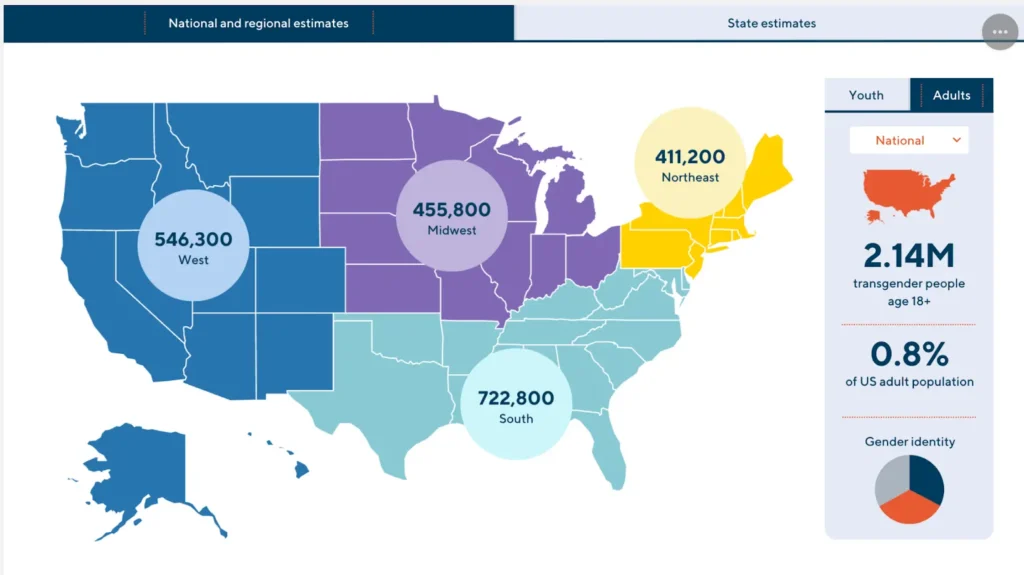
These figures come from comprehensive analysis of federal surveys, specifically the Behavioral Risk Factor Surveillance System and the Youth Risk Behavior Surveillance System. The data sources have improved substantially over the past decade, giving researchers better tools to estimate transgender population size with greater accuracy than ever before.
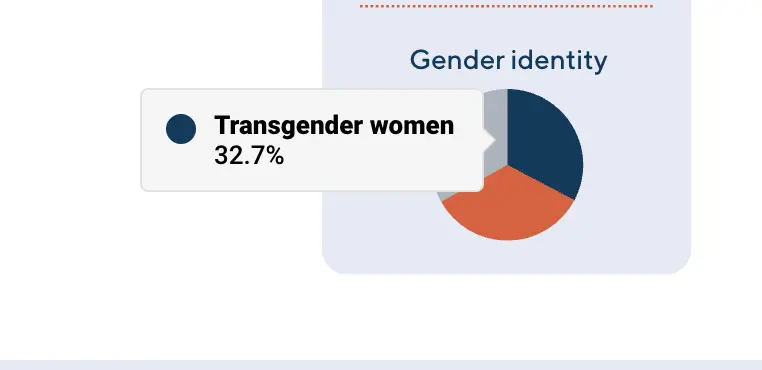
When you break down the adult population by current gender identity, the distribution is fairly consistent across categories.
Of the 2.1 million transgender adults, roughly one-third identify as trans women (32.7%), one-third as trans men (34.2%), and one-third as nonbinary adults (33.1%).
Different federal datasets produce slightly varying estimates depending on their methodology.
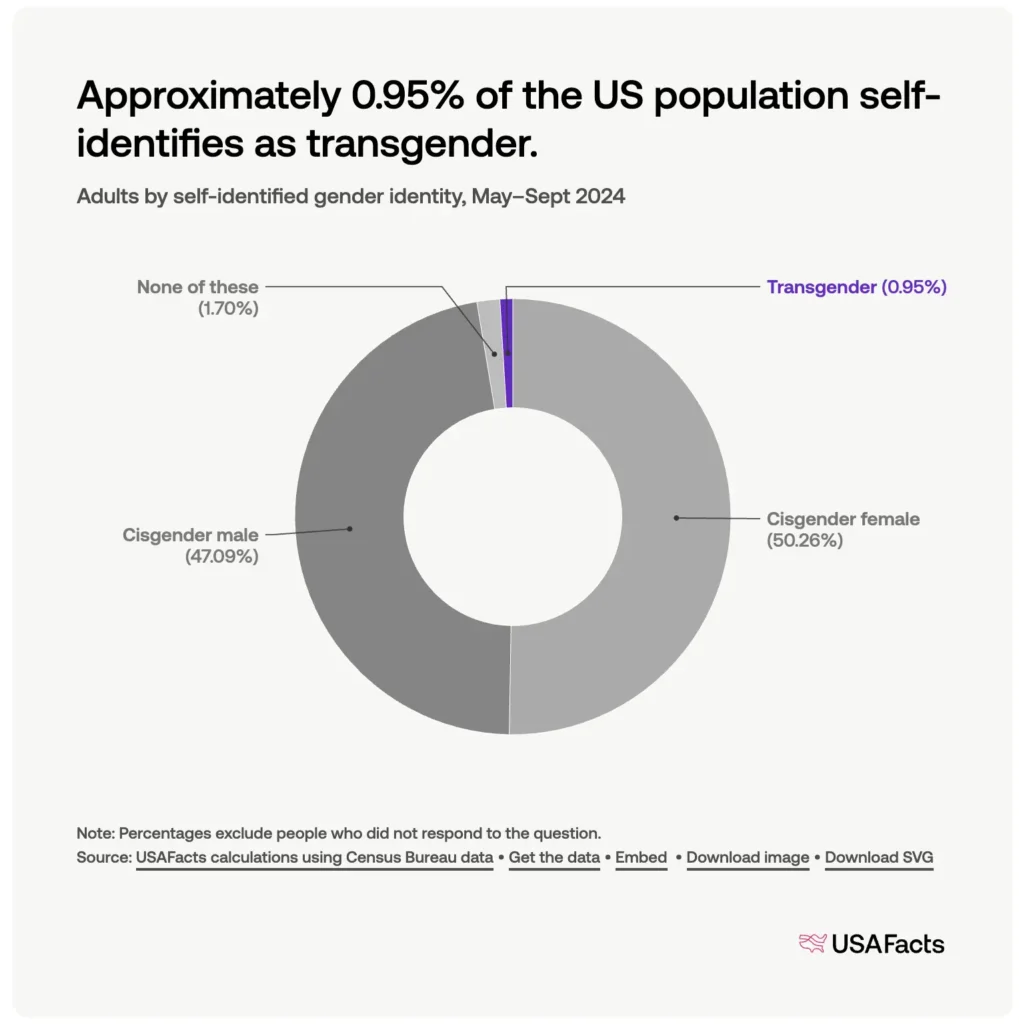
The Household Pulse Survey from mid-2024 found that about 0.95% of the adult population identifies as transgender, equivalent to approximately 2.3 million adults. This variation between surveys isn’t necessarily contradictory—it reflects different sampling methods, question phrasing, and response options.
Connecting with the trans community authentically starts with finding spaces built around respect and understanding. Fiorry offers a transgender dating platform designed specifically to create safe, welcoming connections between trans people and their admirers—no judgment, just genuine human connection.


Why Younger People Are More Likely to Identify as Trans
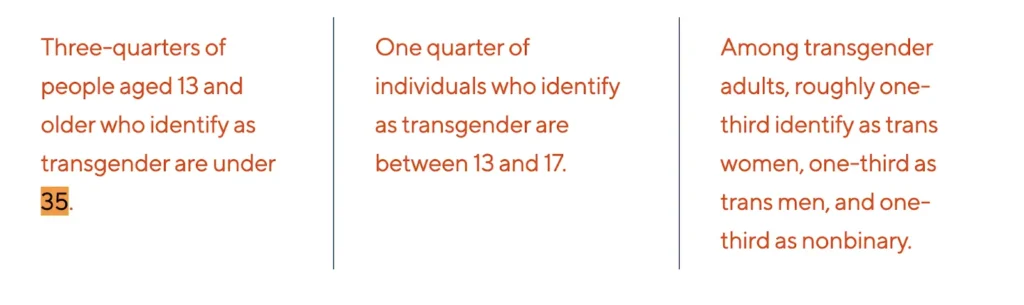
The age gap in transgender identification is one of the most striking findings in recent population-based surveys. Three-quarters of people aged 13 and older who identify as transgender are under 35, compared to just 34% of the entire US population in that same age group.
This isn’t because being transgender is a “trend” or phase—trans people have always existed throughout history.
What’s changed is younger individuals have greater willingness to disclose their identity on surveys and in their daily lives.
Growing up with more visible trans role models, better access to information, and slowly improving social acceptance makes it easier for young trans people to recognize and express who are they.
Among trans adults, those aged 18 to 24 are significantly more likely to identify as transgender compared to those aged 65 and older. This generational difference extends beyond just trans identity—younger Americans across the board are more likely to identify somewhere under the LGBTQ+ umbrella compared to their older counterparts.
The demographic skew toward youth has real implications for public policy, health care access, and community support services. Trans adults and youth face distinct challenges at different life stages, from navigating school systems to accessing age-appropriate medical care.
Geographic Distribution: Where Trans People Live
Regional percentages show relatively modest variation across the United States. For youth aged 13 to 17 who identify as transgender, regional estimates range from 3.2% in the South to 3.4% in the Midwest. Adult estimates show slightly more variation, ranging from 0.7% in the South to 0.9% in the Northeast.
At the state level, differences in how many become more pronounced. State percentages for youth range from 2.5% in Delaware to 3.6% in Hawaii, while adult percentages range from 0.4% in New Mexico to 1.2% in Minnesota.
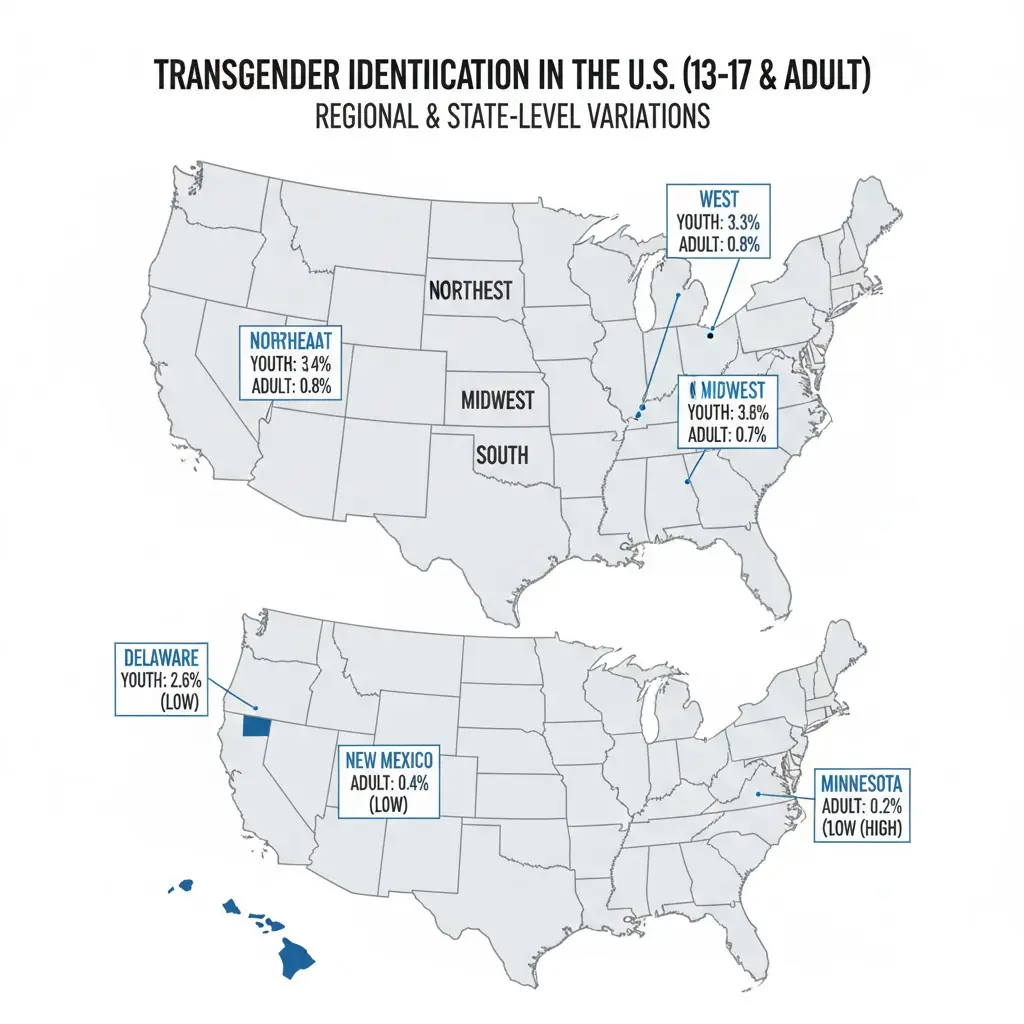
These geographic patterns likely reflect multiple factors: state-level policies affecting trans rights, local community support, economic opportunities, and survey methodology differences. Cities with active LGBTQ+ communities often see more visible trans populations.
Looking to find trans women near me or find local trans near me?
Urban centers typically offer more options for community connection, whether you’re exploring trans dating Boston, hoping to meet trans Philadelphia, connecting with trans in Washington, or finding Baltimore tgirls.
Major metropolitan areas across the South and beyond also have established trans communities.
You’ll find active scenes for Tampa trans dating, meeting Atlanta ts, discovering Orlando trans, and pursuing trans dating in Miami.
Race and Ethnicity Distribution Among Transgender Individuals
The race and ethnicity distribution of adults and youth who identify as transgender appears similar to that of the broader US population, according to Williams Institute findings.
However, nuances exist within specific demographic groups that merit attention.
Previous research has suggested that transgender individuals tend to be less likely to be White and more likely to be Latinx than the general public. The relationship between race, ethnicity, and transgender identity intersects with other factors like socioeconomic status, access to health care, and regional demographics.


Real equality comes from having a national health system that offers consistent, respectful care across all regions, not a lottery based on where you happen to live
Trans people of color face compounded challenges navigating both transphobia and racism. These intersecting identities affect everything from employment opportunities to interactions with law enforcement to access to culturally competent medical care. Understanding the full scope of how race and ethnicity shape transgender experiences remains an active area of research.
How Federal Surveys Track the Transgender Population
Data collection about transgender people has evolved considerably over the past decade. The Centers for Disease Control and Prevention, through federal surveys like the Behavioral Risk Factor Surveillance System, has become a critical information source for understanding transgender population demographics.
These national surveys ask respondents questions about their current gender identity and the sex assigned to them at birth. When these two differ, people are categorized as transgender in the data analysis. Survey data accuracy depends heavily on question design, response options, and how comfortable people feel disclosing personal information.
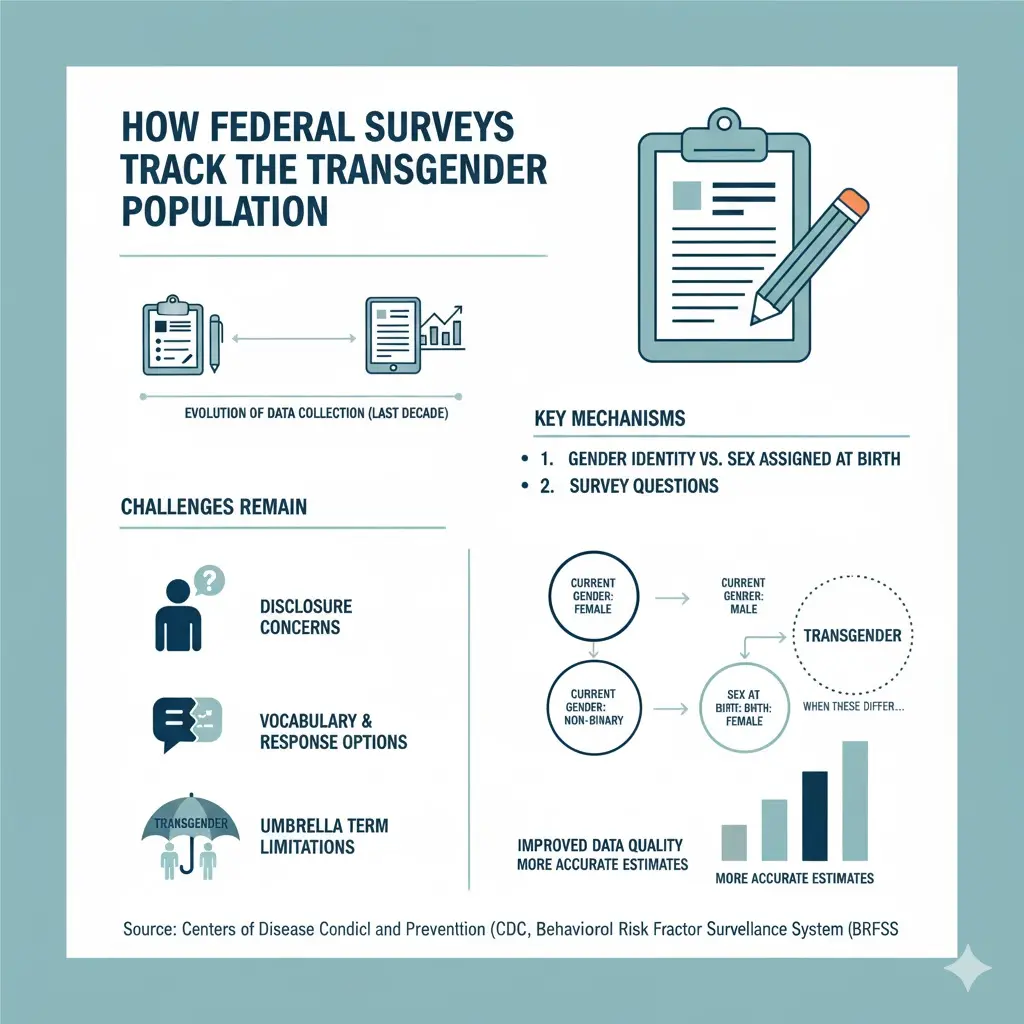
The quality of federal datasets has improved as more surveys include questions specifically designed to capture gender identity. National surveys now provide more accurate estimates than researchers could generate even five years ago. This improved data collection helps policymakers, healthcare providers, and advocacy organizations better understand and serve trans communities.
Still, challenges remain in population-based surveys. Some people may not feel comfortable disclosing their trans identity on government surveys. Others may not have the vocabulary to describe their experiences with the response options provided. The umbrella term “transgender” itself may not resonate with everyone whose sex assigned at birth differs from their current identity.
Understanding the Broader Context of LGBTQ+ Identity
Trans identity exists within the broader landscape of sexual orientation and gender diversity. Recent Gallup polling found that 9.3% of US adults identify as LGBTQ+ in 2024, a figure that has nearly doubled since 2020 and tripled since 2012 when measurement began.
Within the LGBTQ+ population surveyed by Gallup, approximately 1.3% specifically identified as transgender, while others identified as lesbian, gay, bisexual, or another non-heterosexual identity. Many people hold multiple identities simultaneously—someone can be both transgender and gay, for instance.
This broader context matters because trans experiences often get conflated with sexual orientation in public discourse, despite being distinct concepts. Being transgender relates to gender identity (your internal sense of being male, female, both, neither, or somewhere else on the gender spectrum), while sexual orientation describes who you’re attracted to romantically and sexually.
The generational divide appears across LGBTQ+ identities more broadly. More than one in five Gen Z adults identify as LGBTQ+, compared to just 1.8% among those born before 1946. Each successive generation shows higher rates of LGBTQ+ identification, suggesting that increased visibility and acceptance encourages more people to live authentically.
For those curious about meeting trans people through mainstream platforms, there are strategies that work. Wondering how to find trans girls on tinder? While general dating apps are improving their inclusivity, dedicated platforms like Fiorry provide environments specifically designed for trans dating—places where gender identity is respected from the start, not an afterthought.
What the Numbers Don’t Tell Us
Statistics about transgender population percentages provide essential baseline data, but they can’t capture the full complexity of trans experiences. Behind every percentage point are real people navigating employment discrimination, health insurance complications, family relationships, dating challenges, and daily decisions about safety and visibility.
Survey data has inherent limitations. People who feel unsafe disclosing their trans identity won’t be counted. Those who lack the language to describe their experience within survey categories remain invisible in official statistics. Some trans people don’t participate in federal surveys at all, either by choice or circumstance.
The data also can’t capture the richness of gender diversity worldwide. Many cultures recognize gender identities beyond the Western binary framework of male and female. Indigenous communities have their own gender terms and traditions that predate colonization. Reducing global gender diversity to Western survey categories inevitably erases some experiences.
What These Numbers Mean for the Future
Current estimates show that the percentage of the US population who are transgender remains relatively steady over time for adults, with notable increases in visibility among younger age groups. Three-quarters of those aged 13 and older who identify as transgender are under 35, pointing toward continued growth in trans visibility as younger generations age.
But future measurement faces uncertainty. As political climates shift, federal datasets may change or disappear. Whether individuals remain willing to disclose gender identity on surveys depends partly on whether they feel safe doing so. Researchers are uncertain what data sources will be available for more accurate estimates in coming years.
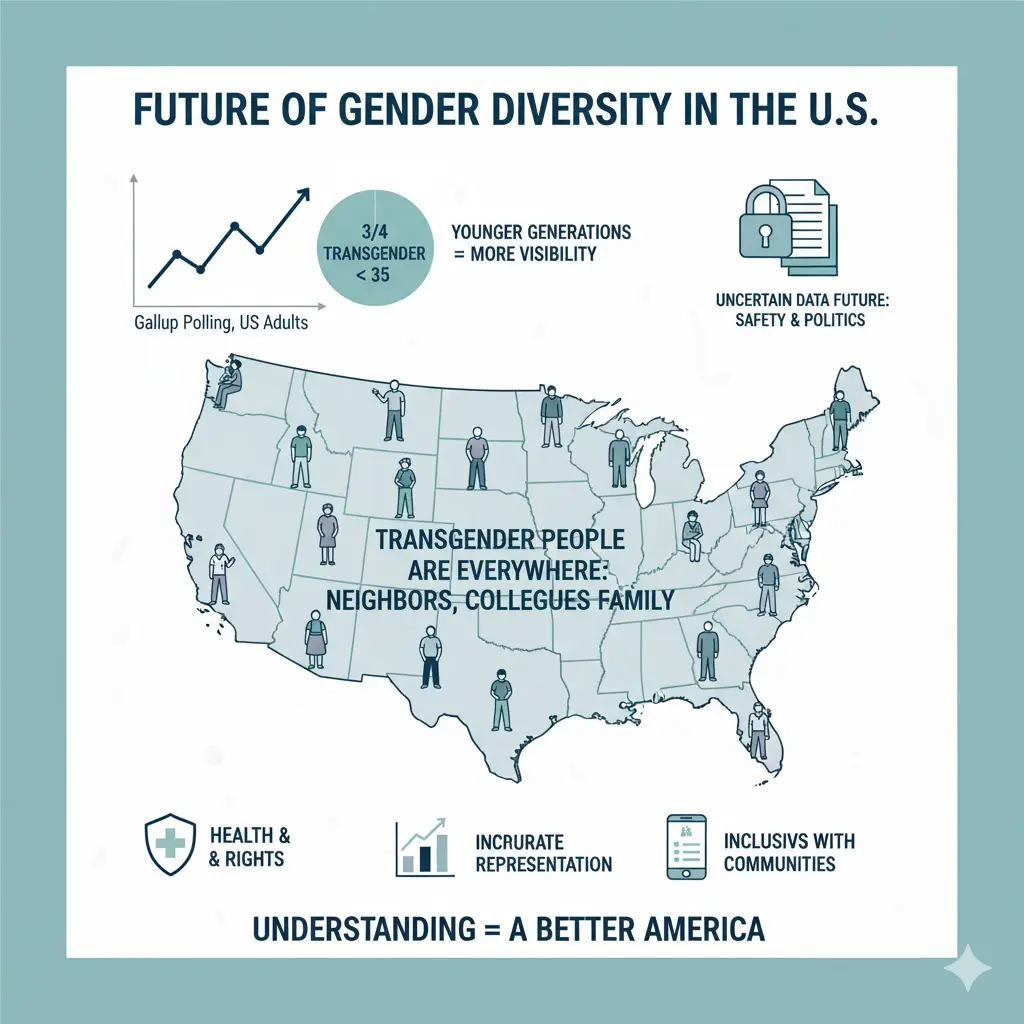
What remains clear is that transgender people are part of every community across America. They’re your neighbors, colleagues, classmates, and family members. They deserve accurate representation in data, access to appropriate health care, protection from discrimination, and the same opportunities to thrive that anyone deserves.
Understanding what percentage of the US population is transgender isn’t just an academic exercise. It informs everything from healthcare planning to civil rights advocacy to how we build inclusive communities. As data collection improves and social acceptance gradually increases, we’ll continue refining our understanding of gender diversity in America.
The statistics matter, but the people behind them matter more. Every percentage represents hundreds of thousands of individuals living authentic lives, navigating challenges, building communities, and contributing to society. That’s the real story worth remembering.
Frequently Asked Questions
What is the percentage of transgender adults and youths in America?
Approximately 0.8% of US adults and 3.3% of youth aged 13-17 identify as transgender, totaling about 1% of the population aged 13 and older—roughly 2.8 million Americans.
Who has the highest transgender population in the world?
Germany and Sweden report the highest percentages at approximately 3% of their populations, though Switzerland showed 6% in a 2023 survey when including non-binary and gender-fluid identities. China and India likely have the largest absolute numbers due to their massive populations, though precise data isn’t available.
What state has the highest transgender population in the US?
Minnesota has the highest percentage of transgender women and men at 1.2%, while Hawaii reports the highest percentage of transgender youth at 3.6%.
What percentage of the US population is transgender?
About 1% of people aged 13 and older in the US identify as transgender—0.8% of adults and 3.3% of youth aged 13-17.
What state has the highest transgender population?
By percentage, Minnesota leads for young adults (1.2%) and Hawaii for youth (3.6%). By absolute numbers, states with larger populations like California and Texas likely have more trans residents, though exact counts vary.
How much of the U.S. population is trans?
Approximately 1% of the US population aged 13 and up is trans, which equals about 2.8 million people total—2.1 million adults and 724,000 youth.
Time to read: 10 min.



Writer
Janet Mock
I believe that telling our stories, first to ourselves and then to one another and the world, is a revolutionary act
Source, February 3, 2014